If You Don't Try to Get It Across, Your Instructional Won't Sell
I've been watching Brazilian jiu-jitsu and grappling instructionals for a long time.
I haven't seen everything out there, of course. But I also film instructionals myself, package them, and sell them, so I've seen a lot of them.
From where I stand, the jiu-jitsu and grappling instructional market today is completely saturated.
01 There are instructionals everywhere
There are just so many.
Compared with 10 or 20 years ago, the number of athletes and instructors around the world selling video is on another level.
But behind that is something particular about jiu-jitsu as a sport.
Jiu-jitsu and grappling grew up alongside match footage and instructional video.
You watch someone's technique on video.
You copy it.
You drill it.
You fold it into your own game.
There actually aren't that many sports where learning technique from video is this normal.
02 What surprised me at the ice rink
My daughter takes figure skating classes, and what I saw there surprised me in the opposite direction.
To learn a new element, you basically have to be taught it directly by a coach.
You take a private lesson, and that's where you learn it.
So is there video to review it on your own afterward? Surprisingly little.
The rink's school doesn't provide any.
The coach doesn't put videos together either.
So you end up searching for videos from abroad and practicing while wondering, "The name's a bit different, but is this the one?"
In other words, just getting to the information is still a real barrier.
I don't think that's only true of figure skating. There must be plenty of activities and sports where people would improve faster if they could watch video.
On that front, jiu-jitsu is far ahead.
You get better by watching video. In jiu-jitsu, that's simply common sense now.
03 What makes the difference is care
And that's exactly why the next problem has arrived.
Now that there are so many instructionals, the quality viewers expect from them has gone way up.
So how do you make sure of that quality?
In the end, I think it comes down to the maker's care.
"Care" might sound like a pep talk. But what I mean is very concrete.
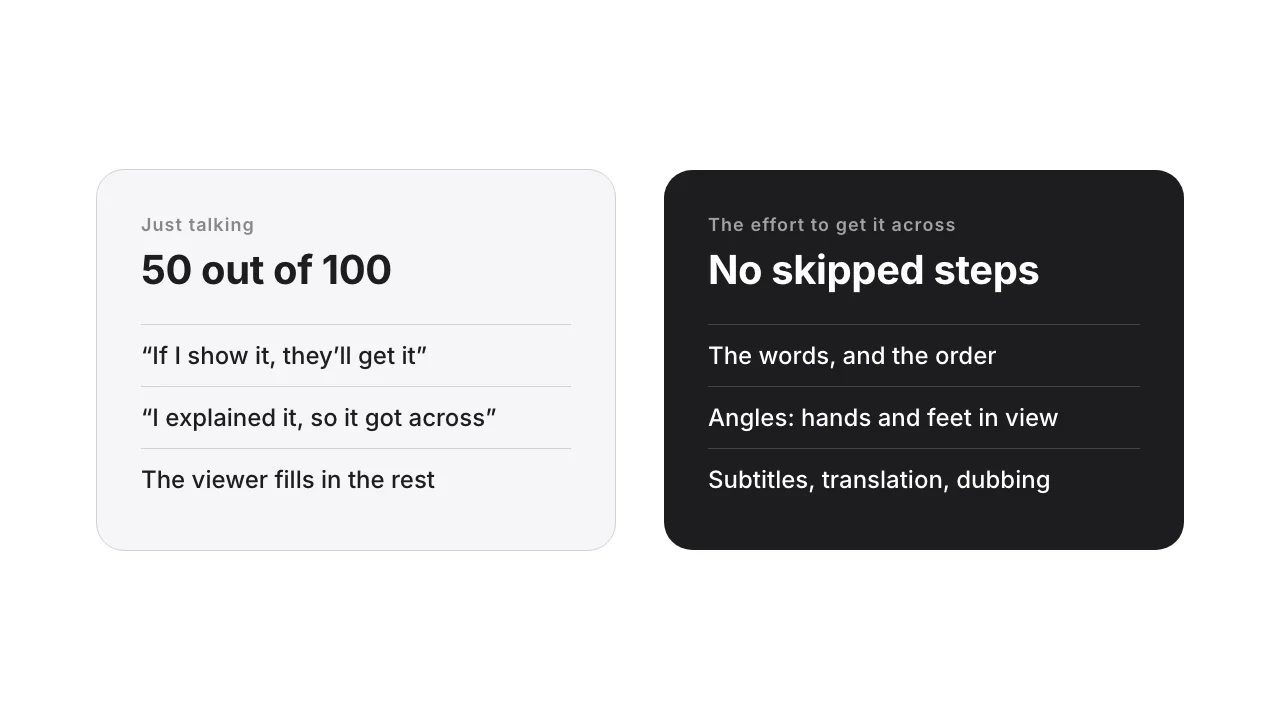
"I can do this move, so if I show it, they'll get it."
"I explained it, so it got across."
There are still a lot of instructionals made that way.
04 Of the 100 in your head, 50 gets through
I've filmed a lot of instructionals. If the instructor has 100 in their head and just talks normally, I think about 50 gets through to the viewer, at best.
Because knowing a technique and getting a technique across are two different skills.
- What words do you use to explain it?
- What do you explain first, and in what order?
- What angle do you film it from?
- Can you actually see the small movements of the hands and feet?
- Is the audio easy to hear?
- Do you add subtitles?
- Do you translate it into other languages?
- Do you add dubbing where it's needed?
- Do you show the part people don't understand again, from another angle?
Today you can raise the quality of an instructional from every one of those directions.
And yet people don't make the effort. I think that's a real waste.
05 Don't lean on the viewer's effort
In the old days, that still worked.
When DVD instructionals were rare, even if they were a bit hard to watch, even if the explanation came up short, that was what you had.
Viewers filled in the gaps themselves: "It probably means this." "This part must mean that."
Sure, that trial and error can be part of learning.
But it's different now.
When there are countless instructionals out there, you can't lean on the viewer's effort.
That's the main thing I want to say this time.
Make the effort to get it across.
You have great jiu-jitsu and grappling concepts. How hard are you working to get them across to people?
Set up a fixed camera and stream your regular class as it is. There's some demand for that, I think.
But of course some people watch it and think, "This is long." "This is hard to follow." "This is boring."
So the people making it should be asking, "How do we get this person's ideas across best?"
06 Digging out what's in their head
When I film instructionals, I say things like this over and over:
"Could you do that part again?"
"Your hand's hidden there, I can't see it."
"Why do you make that move right now?"
"So what you mean is this, right?"
Digging out what's in the instructor's head and shaping it so it reaches the viewer. That's the job of the camera operator and the director, as I see it.
And if you film and sell on your own, you can have the same mindset.
Ichiro Kaneko, who I film with a lot, is incredibly good at getting things across.
Before I even think "I can't see that," he's already moved so I can.
Wherever he thinks "this might be hard for someone seeing it for the first time," he'll explain it as many times as it takes.
07 "In an instructional, say it with certainty"
There's one idea I heard from Kaneko that really stuck with me.
It's this: "In an instructional, it's better to say it with certainty."
Technique is never really absolute.
Bodies are different.
Opponents are different.
Situations are different.
So when you're the one teaching, you want to say:
"It depends, but…"
"It's not absolute, but…"
"You could also do it this way, but…"
But if you explain all of that at once, someone seeing it for the first time won't know what to trust.
So for now, you say it plainly: "Start by doing it like this."
That doesn't mean it's the only right answer in the world.
You give the learner one clear line to follow first. Let it sink in. Then they can take in the exceptions and variations from there.
That idea taught me a lot as I kept making instructionals.
08 A side note: it's the same in class
This isn't only about instructional videos.
Exactly the same goes for how you teach your regular classes.
Some jiu-jitsu gyms teach from a set curriculum. Others have the instructor decide "today I'll teach this" and build the class on the spot.
I've watched a lot of different instructors teach.
And there's one pattern where I've felt, "this is a bit hard to follow."
The talk jumps around.
Say they're in the middle of explaining one technique or concept, and they branch off: "But there's also this case…"
Then from there, off to something else again: "But if your opponent does this…"
Of course, in the instructor's head it all connects. They know so much that related ideas keep coming up, one after another.
But it's not like that for the students.
When students learn a technique, first they want to understand it as one complete thing: "OK, this is how this move works."
If the explanation keeps branching off and never comes back to where it started, they end up not knowing what they're supposed to remember.
Same when the explanation runs too long. Packing in information isn't the same as getting it across.
If anything, at the start it's better to draw one clear line: "Today, start by learning this."
Get them to understand one thing first.
Close the topic there, once.
After that, you add the branches: "By the way, if your opponent does this, here's what happens."
This ties right back to what I wrote above about saying it with certainty.
Because the instructor knows so much, they know the exceptions, the other answers, and how the answer changes with the situation. So they want to explain all of it.
But what a learner needs isn't the whole picture from the start.
First, one path. Once they understand that one, you can show them the second and the third.
It's the same for instructional videos and for regular classes.
Not saying everything you know, but handing it over in an order the other person can follow.
I think that's part of the effort to get it across, too.
09 Where the difference is made in the end
The days when instructionals were scarce are over.
Now, knowing good technique isn't enough. Being a strong competitor isn't enough either.
"How do I shape this great technique so it reaches people best?"
Thinking that far is the job of whoever makes the instructional.
Filming, explaining, editing, subtitles, translation, dubbing. All of it is a way to get it across.
And not skimping on any of those small extra steps. That's what I call the maker's care.
With instructionals everywhere, that's where the difference is made in the end.
An instructional that doesn't try to get it across isn't going to sell.
If you're an athlete or instructor who wants your instructionals to really reach people, subtitles, translation and dubbing included, come and talk to us.
I'm Japanese, but English is no problem for me in writing. In chat I'm very fast. WhatsApp or anything else is fine. I'm a little slow when I talk.
SubPro CEO
Hiromichi Fujiwara
Want it to get across?
SubPro handles subtitles, translation and dubbing. Sell your instructionals one at a time, on a site with your name on it. Talking is free.